
Articles
New Research: Non-Surgical Correction of Severe “Slouchy” Hyperkyphosis Posture
Chiropractic BioPhysics® (CBP®) Protocol Delivers Remarkable Structural & Functional Recovery in Chronic Pain Patient
EXECUTIVE SUMMARY
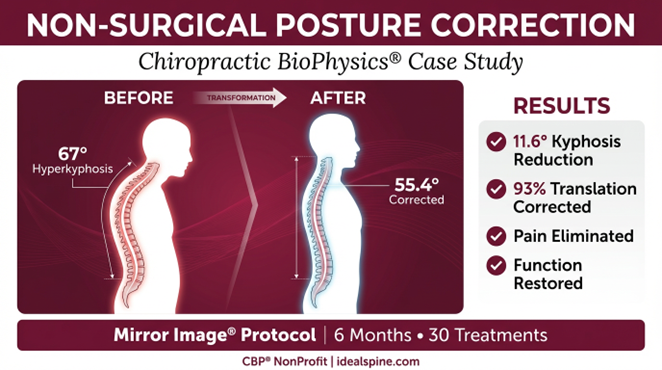
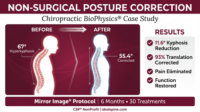
A groundbreaking case study published in the Journal of Physical Therapy Science demonstrates that severe postural deformities—often dismissed as permanent—can be corrected without surgery. Using the multimodal Chiropractic BioPhysics® (CBP®) protocol, a 27-year-old patient achieved an 11.6° reduction in thoracic kyphosis and a massive 93% correction of posterior thoracic translation over just 6 months. These structural changes correlated with the complete resolution of vertigo and upper back pain, alongside dramatic improvements in quality of life.
The Silent Epidemic of Poor Posture
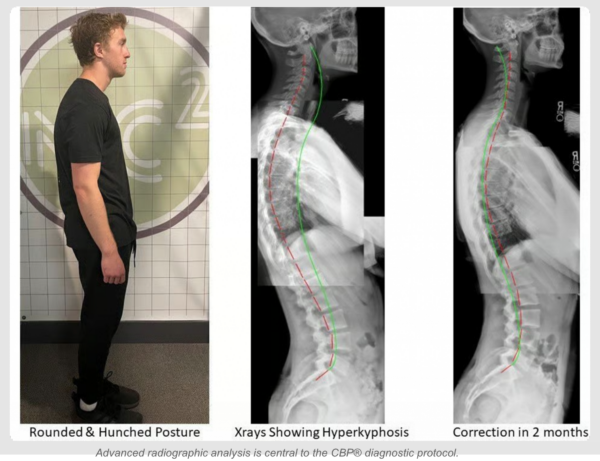
In today’s digital age, “slouchy” posture—clinically known as thoracic hyperkyphosis—has become a pervasive health issue. Far more than an aesthetic concern, hyperkyphosis is associated with chronic pain, respiratory compromise, functional disability, and even increased mortality rates in older populations. Traditional treatments often focus on symptom management through medication or general physical therapy, frequently failing to address the root structural cause.
However, a compelling new case report by Fortner, Oakley, and Harrison (2017) provides robust evidence that structural rehabilitation is not only possible but highly effective for long-term health restoration.
67°
Initial Thoracic Kyphosis (Normal: 44.3°)67°
Initial Thoracic Kyphosis (Normal: 44.3°)
-51.4mm
Initial Posterior Translation (Severe Slouch)-51.4mm
Initial Posterior Translation (Severe Slouch)
Understanding Hyperkyphosis
Thoracic hyperkyphosis is characterized by an excessive forward curvature of the upper back. While a normal thoracic curve measures approximately 44°, curves exceeding 50° are considered hyperkyphotic. This deformity places immense mechanical stress on the spine, leading to muscle fatigue, vertebral wedging, and nervous system tension.
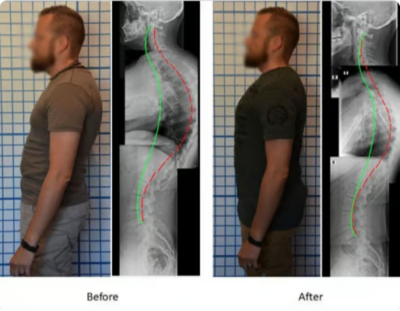
Visualizing the impact of hyperkyphosis on spinal alignment.
Case Overview: A History of Chronic Pain
The patient, a 27-year-old mother of three, presented with a constellation of debilitating symptoms that had plagued her daily life. Her condition included:
- Constant neck pain (Rated 7/10)
- Upper and mid-back pain (Rated 6/10)
- Low back pain (Rated 5/10)
- Daily headaches and migraines
- Vertigo and balance issues
- Numbness and tingling in the arms
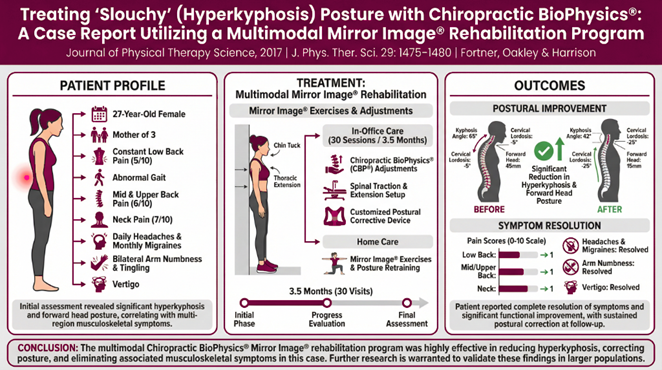
Radiographic analysis revealed a severe 67° thoracic kyphosis and a significant -51.4mm posterior thoracic translation (backward displacement of the upper torso relative to the pelvis). She also exhibited a lateral shift of the spine and a leg length inequality.
The CBP® Mirror Image® Approach
Unlike conventional physical therapy that often uses general strengthening exercises, Chiropractic BioPhysics® employs a highly specific protocol known as Mirror Image® adjustments and exercises. The premise is simple yet biomechanically profound: to correct a spinal distortion, the patient must be placed into the exact opposite posture (the mirror image) and subjected to sustained loading.
This approach stimulates mechanoreceptors and causes soft tissue remodeling (creep deformation), allowing the spine to gradually adopt a more normal alignment.
Comprehensive Treatment Protocol
The patient underwent a 6-month multimodal rehabilitation program consisting of 30 treatment sessions. The protocol included:
1. Mirror Image® Exercises
Customized exercises performed on a PowerPlate® vibration platform to enhance neuromuscular re-education. Key movements included:
- Posterior head retraction (to correct forward head posture)
- Posterior pelvic translation (to correct swayback)
- One-legged stance exercises (to address lateral shift)
2. Mirror Image® Traction
The cornerstone of CBP® structural correction. The patient utilized a Mirror Image® Traction in a supine position. A strap placed at the T9 vertebra exerted an anterior (forward) pull to reduce the backward translation of her ribcage, held for 12-15 minutes per session.
3. Spinal Manipulation & Soft Tissue Work
Targeted drop-table adjustments were applied to mobilize fixated joints, alongside myofascial release techniques for the psoas muscles to address anterior pelvic tilt.
4. Home Care Protocol
To support in-office changes, the patient performed daily traction at home using a dense foam fulcrum (yoga block) placed under the mid-back, alongside corrective exercises and the use of a heel lift.
Remarkable Clinical Results
After 30 visits over 6 months, follow-up X-rays and assessments revealed dramatic improvements that far exceeded typical physical therapy outcomes.
11.6°
Reduction in Thoracic Kyphosis (Improved from 67° to 55.4°)11.6°
Reduction in Thoracic Kyphosis (Improved from 67° to 55.4°)
93%
Correction of Posterior Translation (Improved from -51.4mm to -3.7mm)93%
Correction of Posterior Translation (Improved from -51.4mm to -3.7mm)
82%
Drop in Low Back Disability (ODI score from 44% to 8%)82%
Drop in Low Back Disability (ODI score from 44% to 8%)
100%
Resolution of Vertigo & Upper Back Pain (Symptom free)100%
Resolution of Vertigo & Upper Back Pain (Symptom free)
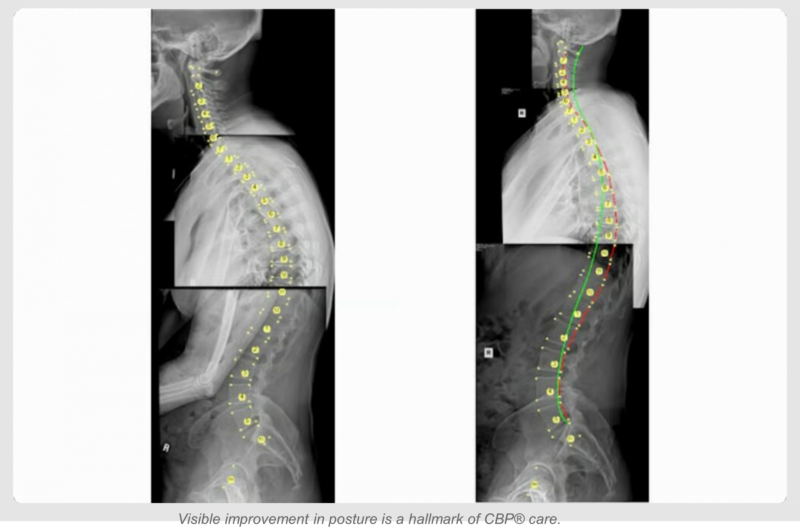
Before & After Comparison Table
| Measurement/Symptom | Baseline (Before) | Outcome (After 6 Months) | Change |
|---|---|---|---|
| Thoracic Kyphosis | 67° (Severe) | 55.4° (Improved) | 11.6° Reduction |
| Post. Thoracic Translation | -51.4 mm | -3.7 mm | 93% Correction |
| Lateral Spine Shift | 12.4 mm | 1.3 mm | Near Complete Correction |
| Oswestry Disability Index (ODI) | 44% (Severe Disability) | 8% (Minimal Disability) | 36 Point Improvement |
| Neck Disability Index (NDI) | 30% (Moderate Disability) | 8% (Minimal Disability) | 22 Point Improvement |
| Vertigo & Upper Back Pain | Severe / Constant | 0/10 (None) | 100% Resolution |
SF-36 Quality of Life Improvements
Perhaps most importantly, the patient’s general health and quality of life skyrocketed. The SF-36 health survey showed massive gains across all 8 domains:
Physical Role Functioning (Ability to work/perform daily tasks)

Improved from 40 to 85 (+112%)
Bodily Pain

Improved from 48 to 78 (+62%)
Vitality / Energy

Improved from 40 to 65 (+62%)
Clinical Significance
“Poor postures corresponding to poor health can be changed for the better with multimodal rehabilitation programs… [This] should be the first line of non-surgical treatment for postural deformities.” — Fortner et al. (2017)
This case challenges the prevailing notion that adult spinal deformities are fixed or progressive. It demonstrates that with the correct application of biomechanical principles—specifically the Mirror Image® traction protocols unique to CBP®—significant structural correction is achievable. For the patient, this meant avoiding the potential need for future surgery and reclaiming an active, pain-free life.
Key Takeaways for Patients
- Posture is Correctable: Even severe, long-standing postural issues in adults can be improved with the right treatment.
- Structure Dictates Function: Correcting the spine’s alignment directly correlates with pain relief and improved organ function.
- Comprehensive Care is Key: Passive treatment (adjustments) alone is rarely enough; active rehabilitation (traction + exercise) is essential for lasting
- Avoid Surgery: CBP® offers a viable, non-invasive alternative for managing spinal deformities like hyperkyphosis.
Conclusion
The successful treatment of this 27-year-old patient underscores the efficacy of Chiropractic BioPhysics® in managing complex spinal conditions. By addressing the root structural cause of her symptoms—the “slouchy” hyperkyphotic posture—clinicians were able to deliver life-changing results. For patients suffering from similar conditions, this research offers a message of hope: your posture, and your health, is not set in stone.
About CBP NonProfit
CBP NonProfit is a 501(c)(3) research foundation dedicated to the advancement of spine rehabilitation through high-quality, peer-reviewed chiropractic and physiotherapy research. With over 300 published studies to date, CBP NonProfit is a global leader in evidence-based spinal care innovation.
Reference:
Fortner MO, Oakley PA, Harrison DE. “Treating ‘slouchy’ (hyperkyphosis) posture with chiropractic biophysics®: A case report utilizing a multimodal mirror image® rehabilitation program.” J Phys Ther Sci. 2017 Aug;29(8):1475-1480.
Share This Story:
About the Authors & CBP Non-Profit
This study was conducted by researchers including Dr. Deed E. Harrison, President of CBP NonProfit Inc. CBP® (Chiropractic BioPhysics®) is one of the most researched chiropractic techniques in the world, focusing on optimal posture and spinal alignment as the primary goals of care. By combining physics, geometry, and biology, CBP® doctors aim to restore normal spinal mechanics to improve overall health.
Recent Posts
CONTACT CBP
CBP Seminars, Inc.
21863 Thorsten Avenue Suite 207
Caldwell, ID 83605
Phone: 208-939-0301
Fax: 208-209-6009
Email: [email protected]
Web: idealspine.com
LATEST ARTICLES
CONTACT CBP
CBP Seminars, Inc.
1160 Taylor Street Suite 100
Meridian, ID 83642
Phone: 208-939-0301
Fax: 208-209-6009
Email: [email protected]
Web: idealspine.com