
Articles
SCIENTIFIC PRESS RELEASE | 2025
New Research Reveals: Forward Head Posture Forces Brain to Work Harder to Maintain Balance
A groundbreaking 2025 study links “Text Neck” to significantly increased cortical stress and neural fatigue, proving that poor posture is a neurological burden, not just a mechanical one.
Eagle, Idaho — April 13, 2026
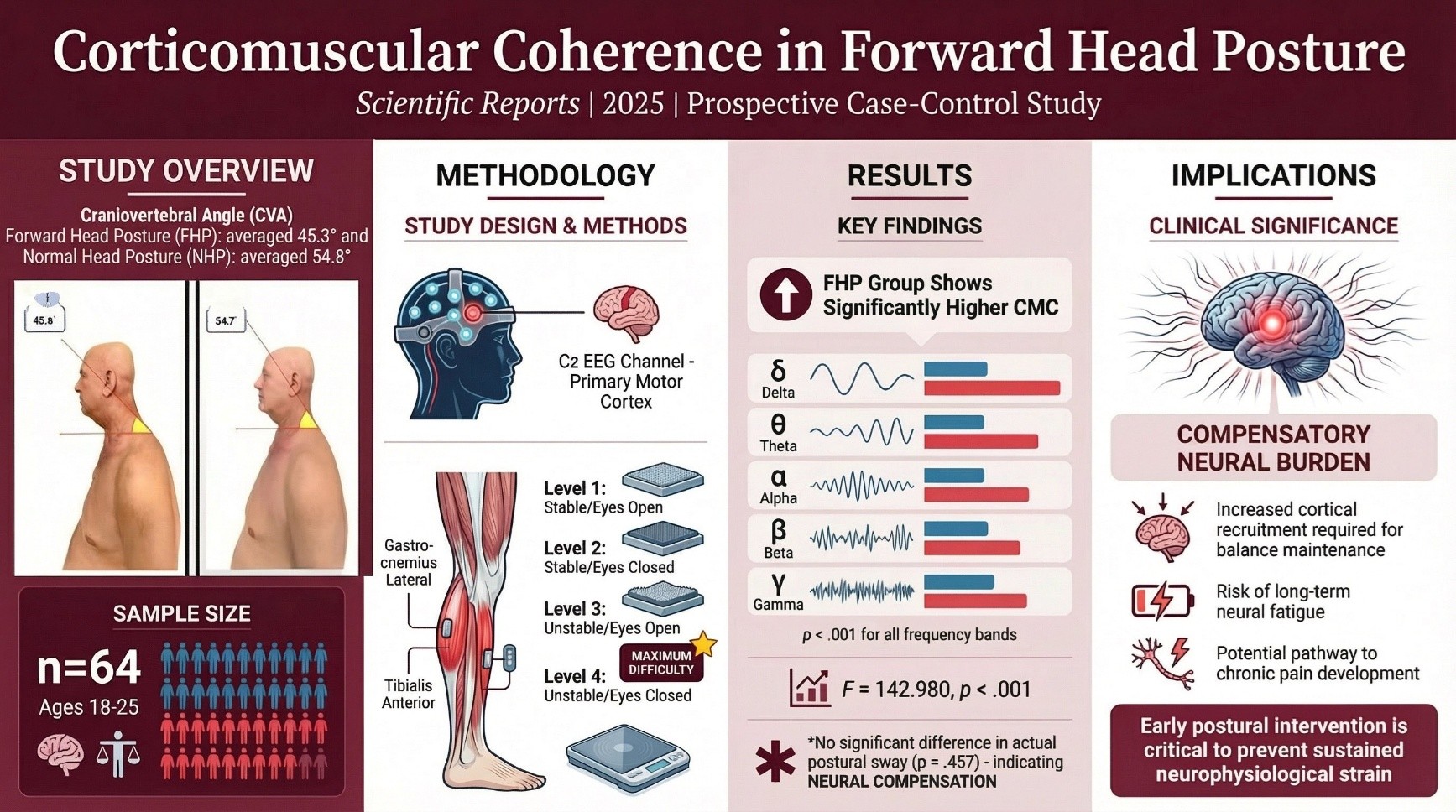
For decades, healthcare providers have understood that Forward Head Posture (FHP) causes mechanical strain on the neck and spine. However, a new study published in Scientific Reports (2025) has uncovered a deeper, invisible consequence: FHP forces the human brain to exert significantly more energy just to keep the body upright.
This prospective case-control investigation provides compelling neurophysiological evidence that structural misalignment acts as a constant “background noise,” requiring the brain to divert valuable neural resources toward basic stability—resources that should be available for other cognitive and motor tasks.
STUDY AT A GLANCE
64
Participants (Ages 18- 25)64
Participants (Ages 18- 25)
<50°
CVA Threshold for FHP<50°
CVA Threshold for FHP
p < .001
Increase in Peak Neural Drivep < .001
Increase in Peak Neural Drive
100%
Frequency Bands Affected100%
Frequency Bands Affected
Key Takeaway: Even in young, asymptomatic adults, poor head posture creates a measurable “compensatory burden” on the central nervous system.
What is Forward Head Posture?
Forward Head Posture (FHP), often dubbed “Text Neck” in the digital age, is defined by the anterior positioning of the head relative to the vertical line of gravity. In this study, researchers used the Craniovertebral Angle (CVA) to classify participants. A CVA of less than 50 degrees indicated FHP, while greater than 50 degrees indicated Normal Head Posture (NHP).
While often dismissed as a cosmetic issue or a minor nuisance, FHP is a growing epidemic among young adults due to prolonged smartphone and computer use. Mechanical stress is well-documented, but the neurological cost has remained largely unmeasured—until now.
The Brain-Body Connection: Understanding CMC
To measure the brain’s workload, the researchers utilized Corticomuscular Coherence (CMC). CMC is a sophisticated analysis that quantifies the communication between the brain’s motor cortex (using EEG) and the muscles executing movement (using EMG).
Think of CMC as the “signal strength” between command and execution. In a highly efficient system, the brain sends a clear signal with minimal effort. When the system is strained, the brain must “shout” to be heard, resulting in higher coherence values in high-frequency bands.
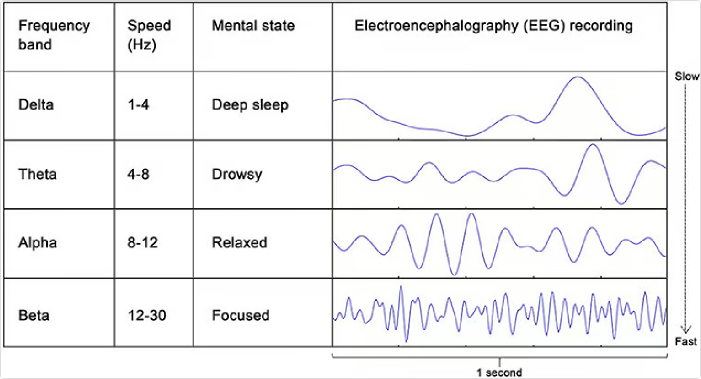
Researchers measured EEG activity across five frequency bands to determine neural load.
Groundbreaking Study Findings
The study challenged 64 participants with four balance tasks of increasing difficulty, from standing on a firm surface with eyes open to standing on an unstable surface with eyes closed. The results were statistically overwhelming:
|
Metric |
Statistical Significance |
Interpretation |
|---|---|---|
| Peak CMC | p < .001 | FHP group required significantly higher peak brain activity. |
| Average CMC | p < .001 | Sustained neural effort was higher in the FHP group. |
| Interaction Effect | p < .01 | As tasks got harder, the FHP group’s brain worked disproportionately harder than the NHP group. |
| Stability Index | p = .457 (NS) | Both groups physically balanced the same; the difference was entirely in neural effort. |
Crucially, all five brain wave frequency bands (delta, theta, alpha, beta, and gamma) showed significant differences (p < .001). The FHP group exhibited a massive spike in beta and gamma activity during challenging tasks. These high-frequency bands are associated with intense concentration and complex motor planning, suggesting the FHP group was mentally “sprinting” just to stand still.
“This study demonstrates that FHP is associated with a significant elevation of CMC, a unique compensatory burden on the brain.”
The Hidden Neural Burden of Poor Posture
The most fascinating finding is that the Stability Index (how much they wobbled) was virtually identical between groups. If you looked at them with the naked eye, both groups appeared to balance equally well.
However, under the hood, the FHP group’s central nervous system was in overdrive. The study proves that the brain treats mechanical misalignment as a complex problem requiring constant, high-level active management. This is a “cognitive-motor dual-task,” where the brain is perpetually distracted by the need to manage its own faulty mechanics.
Clinical Implications: Why This Matters
For healthcare providers and patients, the implications are profound. If the brain is constantly over-recruiting neural resources to manage posture, those resources are unavailable for other tasks. Over time, this state of chronic neural hyper-arousal can lead to:
Central Fatigue: Feeling “brain fog” or exhaustion despite lack of physical exertion.
Decreased Motor Efficiency: Clumsiness or poor coordination in complex sports.
Chronic Pain Syndromes: The constant high-frequency neural drive may sensitize the nervous system to pain.
Why Early Intervention is Critical
The study concludes with a strong recommendation for early postural intervention. Waiting for pain to appear is waiting too long. By the time symptoms manifest, the brain has likely been compensating for years.
Corrective care, such as the protocols utilized in Chiropractic BioPhysics® (CBP), focuses on restoring the normal sagittal curvature of the cervical spine. This study suggests that correcting the structural curve does more than just relieve muscle tension—it may actually unload the brain, restoring neurological efficiency and “quieting” the noise in the central nervous system.
About the Research
This study was conducted by a team including Dr. Ibrahim Moustafa, a prominent researcher in the field of spinal biomechanics and neurophysiology. Dr. Moustafa and colleagues continue to publish leading research validating the connection between spinal alignment and overall health, frequently utilizing Chiropractic BioPhysics (CBP) structural rehabilitation protocols in their investigations.
Reference: Anwar, G., Moustafa, I.M., Khowailed, I. et al. Comparison of corticomuscular coherence under different balance paradigms in individuals with and without forward head posture. Sci Rep15, 22985 (2025). https://doi.org/10.1038/s41598-025-06603-8
Share This Story:
About the Authors & CBP Non-Profit
This study was conducted by researchers including Dr. Deed E. Harrison, President of CBP NonProfit Inc. CBP® (Chiropractic BioPhysics®) is one of the most researched chiropractic techniques in the world, focusing on optimal posture and spinal alignment as the primary goals of care. By combining physics, geometry, and biology, CBP® doctors aim to restore normal spinal mechanics to improve overall health.
Recent Posts

CONTACT CBP
CBP Seminars, Inc.
21863 Thorsten Avenue Suite 207
Caldwell, ID 83605
Phone: 208-939-0301
Fax: 208-209-6009
Email: [email protected]
Web: idealspine.com
LATEST ARTICLES
CONTACT CBP
CBP Seminars, Inc.
1160 Taylor Street Suite 100
Meridian, ID 83642
Phone: 208-939-0301
Fax: 208-209-6009
Email: [email protected]
Web: idealspine.com