
Articles
PEER – REVIEWED · J OSTEOPATH MED · SEPTEMBER 2025
Can Fixing Your Neck Posture Relieve Jaw Pain? A Pilot RCT Says Yes!
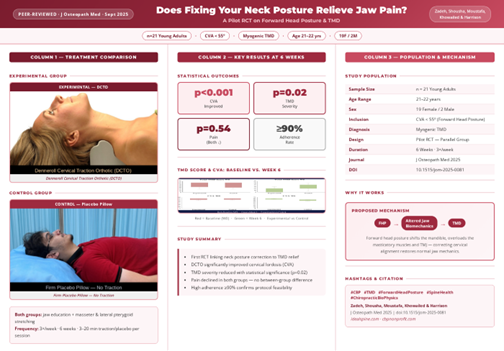
New research from the Journal of Osteopathic Medicine shows that correcting forward head posture with the Denneroll cervical traction orthotic significantly reduces TMD severity — going beyond what conventional jaw therapy alone can achieve.
By Zadeh, Shousha, Moustafa, Khowailed & Harrison | doi:10.1515/jom-2025-0081
≥ 90%ADHERENCE RATE |
21PARTICIPANTS (RCT) |
P = 0.02TMD SEVERITY (W6) |
P < 0.001CVA IMPROVEMENT (W6) |
|---|
The Hidden Connection Between Neck and Jaw
Temporomandibular disorders (TMD) — characterized by jaw pain, restricted mouth opening, and orofacial discomfort — affect an estimated 5–12% of the global population, making them the most common orofacial pain condition after toothache. Yet despite decades of research, conventional treatment often falls short for patients whose pain persists beyond muscle relaxation exercises and lifestyle advice.
A growing body of anatomical evidence points to a surprising upstream cause: forward head posture (FHP). When the head migrates forward relative to the center of gravity — a pattern now endemic among screen users — the cervical spine undergoes biomechanical changes that directly alter mandibular position, hyoid muscle tension, and trigeminal nerve loading.
The jaw, in other words, suffers the consequences of what the neck is doing.
Despite this well-documented anatomical link, no rigorous clinical trial had tested whether correcting forward head posture actually improves TMD outcomes — until now.
The Study: A Pilot Randomized Controlled Trial
Published in September 2025 in the Journal of Osteopathic Medicine, this pilot RCT by Zadeh and colleagues enrolled 21 young adults (age median 21–22 years, 19 female) diagnosed with myogenic TMD and confirmed forward head posture (craniovertebral angle <55°). All participants had failed to resolve symptoms through conventional means and were randomly allocated to one of two groups for a 6-week protocol:
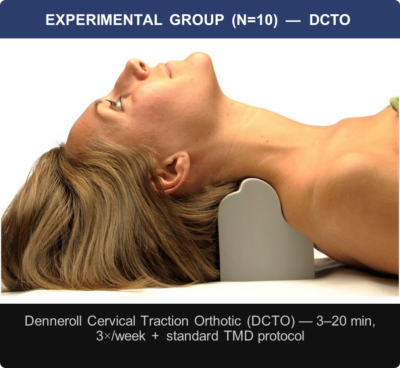
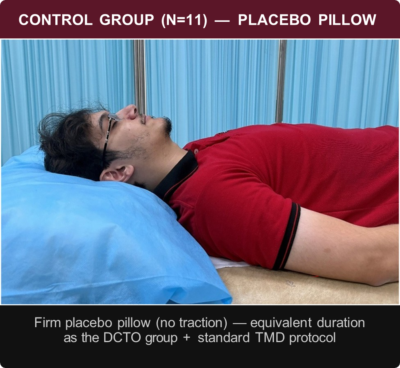
The conservative TMD protocol — jaw resting position education, masseter stretching, and lateral pterygoid stretching (3–5 reps × 20–30 sec) — was identical in both groups. The experimental group additionally used the Denneroll Cervical Traction Orthotic (DCTO), a contoured foam device that induces passive cervical extension traction while supine. Sessions were progressively loaded from 3 to 20 minutes over 6 weeks.
CONSORT Flow: Who Was Studied
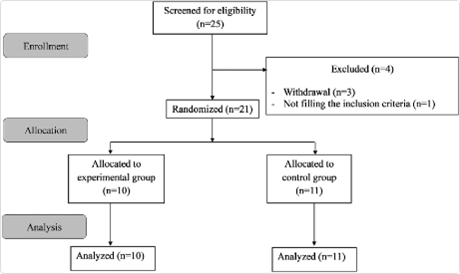
Figure 1. CONSORT flow diagram: 25 participants screened, 4 excluded (3 withdrew, 1 ineligible), 21 randomized and analyzed (10 experimental, 11 control).
The Results: Neck Posture and Jaw Pain Move Together
After 6 weeks of treatment, the study revealed a clear separation between the two groups on the outcomes most directly tied to structural change — while both groups improved on symptom-level measures:
CVA BETWEEN GROUP
p<0.001Week 6 (significant) |
TMD SEVERITY
p=0.02Week 6 (significant) |
NRS PAIN
p=0.54Both groups improved |
MMO
p=0.42Both groups improved |
ADHERENCE ≥ 90%Both groups |
|---|
| Outcome | DCTO Group Baseline (W0) | DCTO Week 6 | Ctrl Baseline (W0) | Ctrl Week 6 | Between-Group p (W6) |
|---|---|---|---|---|---|
| CVA (°) | 51.35° | ~60° | 53.30° | 52° | <0.001 ✓ |
| TMD Score | 45.0 | ~10 | 50.0 | ~25 | 0.02 ✓ |
| NRS Pain | 3.50 | Improved | 2.00 | Improved | 0.54 NS |
| MMO (mm) | 38.5 | Improved | 43.0 | Improved | 0.42 NS |
The craniovertebral angle diverged between groups as early as Week 3 (p=0.01), confirming that structural changes in cervical alignment occur within the first half of the protocol. By Week 6, the gap was highly significant (p<0.001), and TMD severity — measured by the validated Fonseca Anamnestic Questionnaire — showed the experimental group achieving near-normal scores (~10 points) compared to the control group’s mild-moderate range (~25 points).
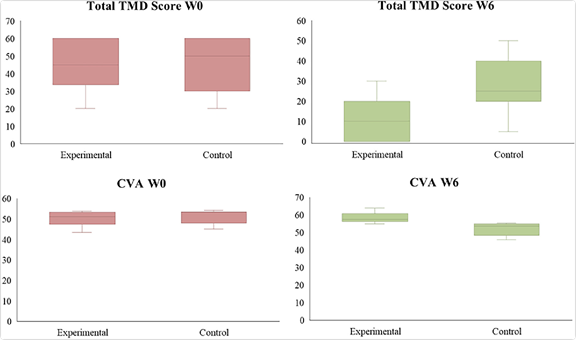
Figure 2. Box plots comparing Total TMD Score (top) and CVA (bottom) between Experimental and Control groups at Week 0 (W0, baseline, red) and Week 6 (W6, green). The experimental group shows markedly lower TMD scores and higher CVA at Week 6.
“Correcting cervical alignment with the Denneroll Cervical traction orthotic reduced TMD severity significantly beyond what standard jaw therapy could achieve alone — suggesting forward head posture is not merely associated with jaw dysfunction, but mechanistically contributing to it.”
Why Conservative Therapy Alone Wasn’t Enough
Importantly, both groups showed within-group improvement in all measured outcomes (Friedman test p<0.001 for all). The stretching and jaw education protocol clearly provides real therapeutic benefit. However, the between-group comparisons reveal that orofacial pain and mouth opening can improve without resolving the underlying structural driver — the persistent forward head position that mechanically loads the TMJ.
The authors note that the delay in TMD score divergence (significant at Week 6 but not Week 3) mirrors findings from CBP® spinal traction studies: structural ligamentous remodeling via hysteresis requires sustained traction over weeks, not days.
Clinical Significance & What Comes Next
The pilot demonstrated an effect size of 0.53 for TMD severity, indicating a medium- to-large clinical effect. Based on this, the authors calculated that a full-scale RCT would require 38 participants (19 per group) with α = 0.05 and power = 0.80 to confirm these findings definitively. The ≥ 90% adherence rate in both groups confirms the DCTO protocol is clinically feasible and acceptable.
These findings carry broad implications: the estimated 50 million TMD sufferers in the United States, many of whom also present with neck pain and postural dysfunction, represent an undertreated population that may benefit substantially from a structural posture-correction approach as an adjunct to standard TMD care.
Reference
Zadeh SA, Shousha T, Moustafa IM, Khowailed I, Harrison DE. Does forward head posture correction improve temporomandibular joint dysfunction? A pilot randomized trial using a cervical extension traction orthotic. J Osteopath Med. 2025. doi:10.1515/jom-2025-0081
#CBP #TMD #ForwardHeadPosture #SpineHealth #ChiropracticBioPhysics #JawPain
Suffering from jaw pain or poor posture?
Share This Story:
About the Authors & CBP Non-Profit
This study was conducted by researchers including Dr. Deed E. Harrison, President of CBP NonProfit Inc. CBP® (Chiropractic BioPhysics®) is one of the most researched chiropractic techniques in the world, focusing on optimal posture and spinal alignment as the primary goals of care. By combining physics, geometry, and biology, CBP® doctors aim to restore normal spinal mechanics to improve overall health.
Recent Posts
CONTACT CBP
CBP Seminars, Inc.
21863 Thorsten Avenue Suite 207
Caldwell, ID 83605
Phone: 208-939-0301
Fax: 208-209-6009
Email: [email protected]
Web: idealspine.com
LATEST ARTICLES
CONTACT CBP
CBP Seminars, Inc.
1160 Taylor Street Suite 100
Meridian, ID 83642
Phone: 208-939-0301
Fax: 208-209-6009
Email: [email protected]
Web: idealspine.com